In reinforced concrete construction, concrete and steel reinforcement perform different but complementary jobs. Concrete provides strong compressive resistance, while steel reinforcement helps carry tensile stresses. For these materials to function effectively as one structural system, a reliable bond between them is essential.
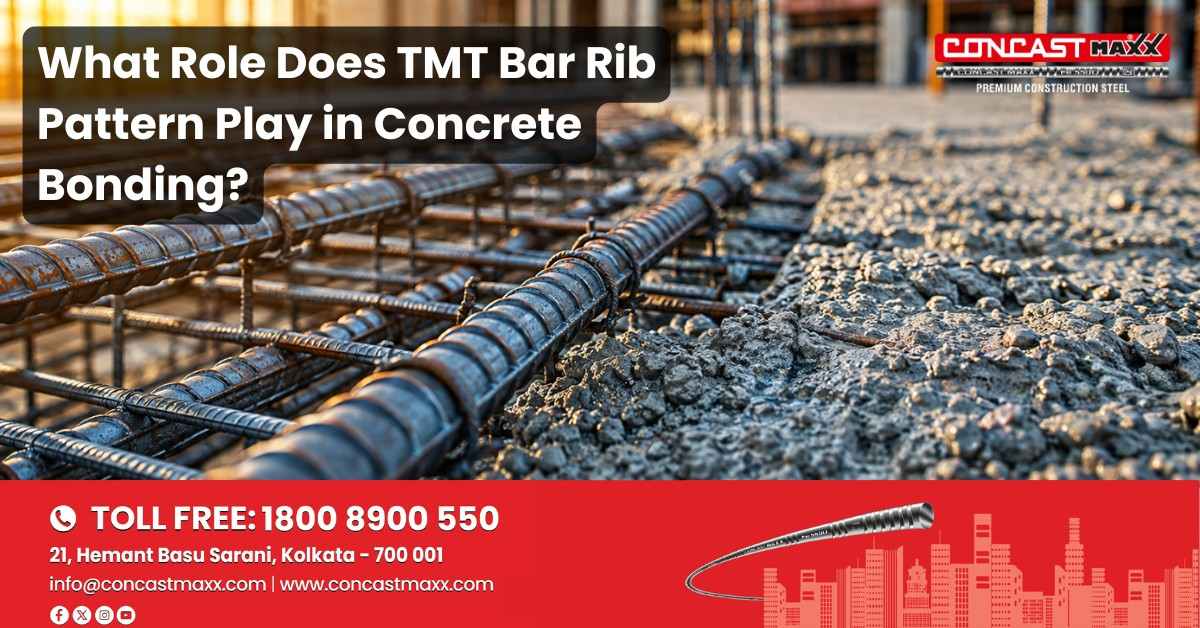
One of the key features that supports this bond is the rib pattern on a TMT bar. The ribs are designed to create mechanical interlocking between the reinforcement and the surrounding concrete. Their height, spacing, shape, and arrangement can influence how effectively forces are transferred from concrete to steel and vice versa.
Understanding the role of rib geometry can therefore help builders, contractors, and buyers make more informed decisions when selecting reinforcement steel.
A TMT bar with a ribbed surface provides more than simple contact between steel and concrete. When concrete hardens around the bar, it grips the ribs and forms a mechanical connection.
When the reinforcement is subjected to tensile forces, the surrounding concrete interacts with these ribs and resists the bar’s tendency to slide. This mechanical interlocking contributes significantly to bond behaviour.
Compared with a plain surface, a properly deformed reinforcement surface can provide stronger interaction with concrete. This allows stresses to be transferred along the embedded length of the reinforcement more effectively.
Rib height and spacing are important aspects of reinforcement geometry. The height determines how far the ribs project from the bar surface, while spacing determines the distance between successive ribs.
If the geometry is properly designed, the ribs can provide effective mechanical engagement with the surrounding concrete. However, larger or more prominent ribs do not automatically mean better bonding.
The relationship between rib height, spacing, rib inclination, concrete strength, and other factors influences overall bond behaviour. Therefore, rib geometry needs to be consistent and appropriate rather than simply appearing aggressive or deep.
When a reinforced concrete member carries a load, forces need to move between the concrete and reinforcement. This transfer occurs through the bond along the embedded length of the steel.
The ribs create bearing surfaces against the surrounding concrete. As loading increases, these areas contribute to transferring stresses between the two materials.
Effective stress transfer helps reinforcement perform its intended structural function while reducing unwanted slipping within the concrete. This is particularly relevant in structural components such as beams, columns, slabs, foundations, and other reinforced concrete elements.
Yes, but it is important not to oversimplify the relationship.
A suitable rib pattern can contribute to effective bond behaviour, but the overall performance of reinforced concrete depends on many factors. Concrete quality, reinforcement grade, bar diameter, embedment length, concrete cover, placement accuracy, compaction, curing, and loading conditions can all influence performance.
Therefore, a good rib pattern should be viewed as one component of reinforcement quality rather than the sole indicator of structural reliability.
Buyers should not select reinforcement steel simply by looking at how prominent the ribs appear. Surface appearance alone cannot establish the quality or structural performance of a bar.
Instead, buyers should consider:
For reinforcement steel covered under IS 1786, requirements include mechanical properties, dimensions, surface characteristics, and other quality parameters. Buyers should verify that the material supplied meets the applicable requirements rather than relying only on visual inspection.
Not necessarily.
This is an important misconception. Simply increasing rib height or changing the appearance of the ribs does not guarantee superior concrete bonding.
Bond behaviour is influenced by the complete deformation geometry as well as concrete properties and loading conditions. Poorly designed or inconsistent deformation can produce undesirable stress concentrations or affect the way forces are transferred.
The objective is effective and consistent mechanical interaction, not simply larger ribs.
Even a technically suitable rib design becomes less useful if it is not produced consistently.
During manufacturing, variations in rib height, spacing, diameter, or surface characteristics can create differences between bars or batches. Consistency is therefore important for predictable reinforcement performance.
Quality-controlled manufacturing helps ensure that reinforcement steel conforms to the required specifications and delivers more uniform characteristics across construction projects.
Q1. Why do TMT bars have ribs?
TMT bars have ribs to improve mechanical interlocking with surrounding concrete. This helps transfer forces between the reinforcement and concrete and reduces the tendency of the bar to slip.
Q2. Does rib height determine the quality of a TMT bar?
No. Rib height is only one aspect of reinforcement geometry. Mechanical properties, ductility, dimensional accuracy, manufacturing consistency, and compliance with applicable standards also matter.
Q3. Does rib spacing affect concrete bonding?
Yes. Rib spacing influences the interaction between the reinforcement surface and surrounding concrete. Proper spacing works together with rib height and geometry to support effective bond behaviour.
Q4. Can rib pattern improve reinforcement performance?
A suitable rib pattern can contribute to effective stress transfer and resistance to slip. However, overall reinforcement performance also depends on steel properties, concrete quality, detailing, and construction practices.
Q5. Can buyers judge a TMT bar only by looking at its ribs?
No. Visual inspection is useful but insufficient. Buyers should also check applicable standards, mechanical properties, dimensional consistency, quality certificates, and other test documentation.
Q6. Why is consistent rib geometry important?
Consistent rib geometry helps provide more predictable interaction between reinforcement and concrete. Manufacturing consistency is therefore an important part of overall reinforcement quality.
The rib pattern on a TMT bar is more than a surface feature. It contributes to the mechanical interlocking between reinforcement steel and concrete, helping facilitate stress transfer and resist unwanted movement within reinforced concrete.
However, rib appearance should never be treated as the sole measure of quality. Rib geometry, steel properties, dimensional consistency, manufacturing control, standard compliance, and concrete quality all work together to influence reinforcement performance.
For builders and contractors, understanding this relationship makes it easier to evaluate reinforcement steel based on engineering characteristics rather than appearance alone. In construction, the goal should not be simply to choose steel with visible ribs, but to choose reinforcement with consistent, verified, and specification-compliant properties that support dependable structural performance.