
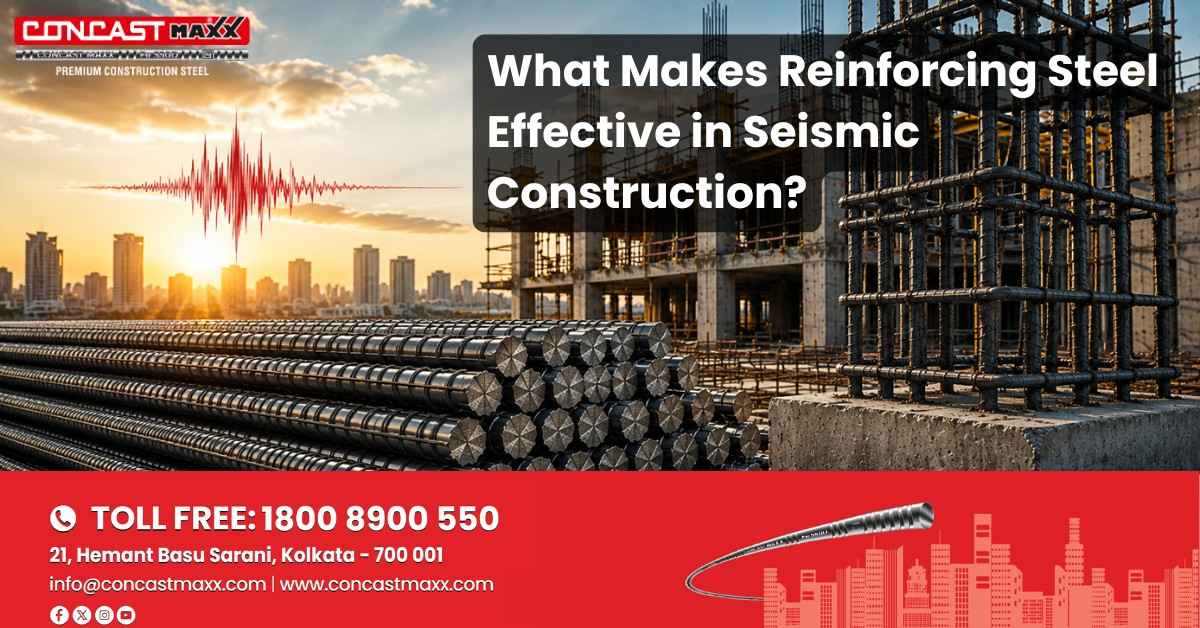
Earthquakes subject buildings to sudden, reversing, and dynamic forces that can cause structural members to bend, crack, and deform. In reinforced concrete construction, reinforcing steel therefore needs to provide more than high strength. It must work effectively with concrete and have the ability to undergo controlled deformation under demanding conditions. This is why strength, ductility, bonding, bendability, and manufacturing consistency are important when selecting reinforcement steel for seismic construction.
Ductility is one of the most important properties of reinforcement steel used in earthquake-resistant structures. During an earthquake, structural members can experience repeated and changing stresses. Ductile reinforcement can undergo substantial deformation while continuing to carry load, allowing the structure to absorb and redistribute energy rather than experiencing sudden brittle failure. Indian seismic provisions place significant emphasis on ductile design and detailing for reinforced concrete structures subjected to earthquake forces.
Reinforcing steel needs adequate yield and tensile strength to resist the stresses developed within beams, columns, structural walls, and other reinforced concrete members. However, higher strength should not automatically be considered better for every seismic application. The selected grade must match the structural design, detailing requirements, and applicable standards. A balanced combination of strength and ductility is more important than choosing reinforcement solely because it has a higher strength value.
Reinforcing steel and concrete need to work together as a combined structural system. The ribs on deformed reinforcement create mechanical interlocking with the surrounding concrete, helping transfer forces between the two materials. Reliable bonding reduces unwanted movement of reinforcement inside concrete and allows stresses to be transferred effectively along the embedded length of the bar. During earthquake loading, when reinforcement can experience repeated and reversing stresses, consistent bond behaviour becomes particularly important.
Seismic structures often require reinforcement to be bent into specific shapes around beams, columns, joints and other structural elements. Reinforcement therefore needs suitable bending and rebending characteristics so that it can be fabricated according to the required detailing without unacceptable damage. Proper bending performance also depends on using appropriate fabrication methods and following the structural drawings. Steel quality alone cannot compensate for incorrect bar bending, poor anchorage, or improper reinforcement detailing.
The grade marked on reinforcement steel is not enough to establish its overall quality. Consistency in yield strength, tensile strength, elongation, chemical composition, dimensions, and surface deformation is important for predictable performance. Quality-controlled manufacturing and proper testing help ensure that reinforcement meets the applicable requirements. Buyers should therefore consider test certificates and batch-wise quality documentation instead of relying only on the appearance or grade marking of the bars.
For seismic construction, builders and contractors should check whether the reinforcement complies with applicable Indian Standards and the project’s structural specifications. They should consider strength, ductility, dimensional accuracy, rib geometry, bend and rebend performance, chemical composition, and relevant quality-test results. The selected reinforcement should also be compatible with the structural engineer’s design. Buying steel solely on price or choosing the strongest available grade without considering the design requirements can lead to the wrong material selection.
No. This is an important distinction. Reinforcing steel is only one part of an earthquake-resistant structural system. Seismic performance also depends on structural configuration, concrete quality, reinforcement detailing, beam-column connections, foundations, construction workmanship, and compliance with seismic design provisions. Even high-quality reinforcement cannot compensate for inadequate structural design or poor construction practices.
Why is ductility important during an earthquake?
Ductility allows reinforcement steel to deform while continuing to carry load, helping structural members respond to severe and repeated earthquake forces without sudden failure.
Is stronger reinforcement always better for seismic construction?
No. Strength is important, but it must be considered together with ductility and the requirements of the structural design. Selecting a higher grade simply because it is stronger is not sound engineering practice.
Does rib pattern affect seismic performance?
Yes. Rib geometry contributes to mechanical interlocking between reinforcement and concrete, supporting effective stress transfer and reducing unwanted reinforcement slip.
Why are bend and rebend properties important?
These properties indicate how reinforcement responds when it is shaped during fabrication. Proper bending performance is important because seismic detailing often requires carefully formed reinforcement around structural joints and members.
Can reinforcement steel alone prevent earthquake damage?
No. Earthquake resistance depends on the complete structural system. Reinforcement quality, structural design, concrete quality, detailing, and construction practices must all work together.
Effective reinforcement steel for seismic construction is defined by more than a high strength rating. Strength, ductility, bond performance, bendability, dimensional consistency, and manufacturing quality all contribute to dependable reinforcement performance. For builders and project owners, the right approach is to select reinforcement according to the structural engineer’s design and applicable standards, verify its properties through reliable testing and documentation, and ensure that it is correctly detailed and placed. In seismic construction, good steel matters, but good engineering and good workmanship matter just as much.