
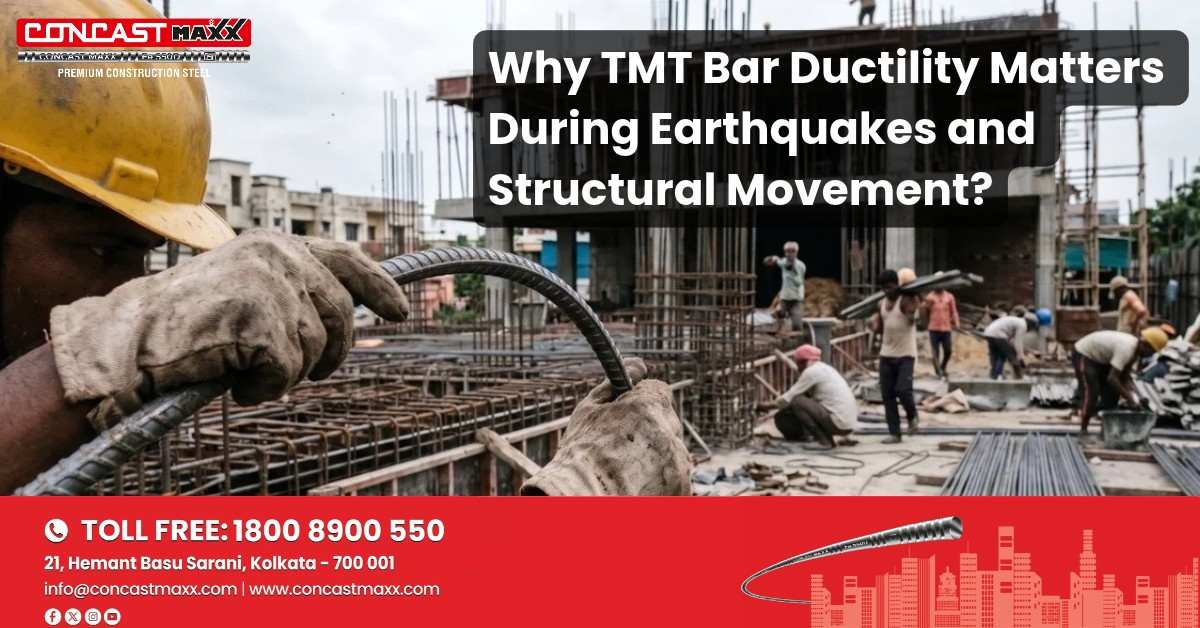
When evaluating reinforcement steel for a building, strength is often the first property buyers consider. However, strength alone does not explain how steel behaves when a structure experiences sudden or repeated movement. Ductility is another important property because it describes a material’s ability to deform plastically before fracturing.
For buildings in Kolkata and other parts of West Bengal, understanding ductility helps homeowners and construction professionals recognise why reinforcement selection must follow structural design requirements rather than price or strength claims alone.
Ductility refers to a material’s capacity to undergo permanent deformation before breaking. In steel reinforcement, this behaviour can be assessed through properties such as elongation measured during tensile testing.
A ductile steel bar can accommodate a degree of deformation without immediately fracturing. This characteristic is important when reinforced concrete members experience forces that cause bending, tension, or other forms of structural response.
However, ductility should not be confused with softness or a lack of strength. Reinforcement needs an appropriate combination of mechanical properties to perform its intended role within the concrete structure.
During an earthquake, ground movement produces forces that can change rapidly in magnitude and direction. Depending on the building’s design and the intensity of the event, structural members may experience repeated loading, bending, and deformation.
In properly designed earthquake-resistant structures, ductile behaviour can allow designated structural components to deform and dissipate energy without sudden brittle failure. This behaviour can help provide warning through visible damage and support the intended structural response under severe loading.
The overall performance, however, depends on much more than the steel itself. Structural configuration, member dimensions, reinforcement detailing, concrete quality, connections, and construction workmanship all influence how a building responds to earthquake forces.
Ductile reinforcement cannot make an inadequately designed building earthquake-safe on its own.
Concrete performs well under compression but has comparatively limited tensile capacity. Steel reinforcement helps resist tensile forces and works with concrete to form reinforced cement concrete, commonly known as RCC.
When a beam bends under loading, for example, different parts of the member experience different stresses. Reinforcement is positioned according to the structural design to resist the forces expected in that member.
The steel’s mechanical properties influence how it responds as the load increases. Adequate ductility can help reinforcement accommodate deformation in situations where the structure is designed to undergo controlled yielding.
For this reason, selecting TMT bars for reinforced concrete structures should involve checking the specified grade and relevant mechanical properties, not simply comparing advertised strength figures.
TMT bars are available in different grades, with specified mechanical properties that determine their suitability for different structural applications. A higher yield-strength value does not automatically mean that a product is the best choice for every project.
The structural engineer selects reinforcement according to design loads, applicable standards, detailing requirements, and the intended behaviour of the structure.
Ductile variants, such as grades designated with the letter D, have specific requirements relating to ductility under the applicable product standard. Buyers should verify the actual grade and relevant test documentation instead of relying on the product name alone.
The correct choice is the reinforcement specified for the project, supplied with appropriate identification and quality documentation.
Buyers should begin by confirming the grade and diameter stated in the structural drawings. They should also check manufacturer identification, relevant conformity documentation, and available test results for the supplied material.
Mechanical properties such as yield strength, tensile strength, and elongation provide different information about how steel behaves under load. These properties should be interpreted against the applicable standard and the requirements of the structural design.
Price, brand visibility, and general marketing statements are not substitutes for technical verification. If a supplier proposes a different grade or product from the one specified, the change should be reviewed by the responsible structural engineer before purchase or use.
Construction quality matters after delivery, too. Correct storage, handling, cutting, bending, placement, and concrete cover help ensure that the reinforcement is installed as intended.
Even high-quality ductile reinforcement cannot compensate for poor structural design, weak connections, unsuitable foundations, or careless construction. Earthquake performance depends on the complete building system.
Engineers must consider the relevant seismic design requirements, structural configuration, load paths, reinforcement detailing, and quality control. Contractors must follow approved drawings, while site inspections should identify deviations before they become concealed.
Homeowners can contribute by appointing qualified professionals, requesting appropriate documentation, and ensuring that construction decisions are not driven solely by short-term cost savings.
TMT bar ductility matters because it influences how reinforcement behaves when a structure experiences deformation under load. In earthquake-resistant design, suitable ductility can support controlled structural behaviour and energy dissipation when combined with correct engineering and construction practices.
For buildings in Kolkata and across West Bengal, the priority should be to select reinforcement that meets the structural specification and applicable quality requirements. Strength, ductility, detailing, and workmanship must work together. No single steel property can guarantee a building’s safety, but understanding these properties helps buyers make more informed construction decisions.