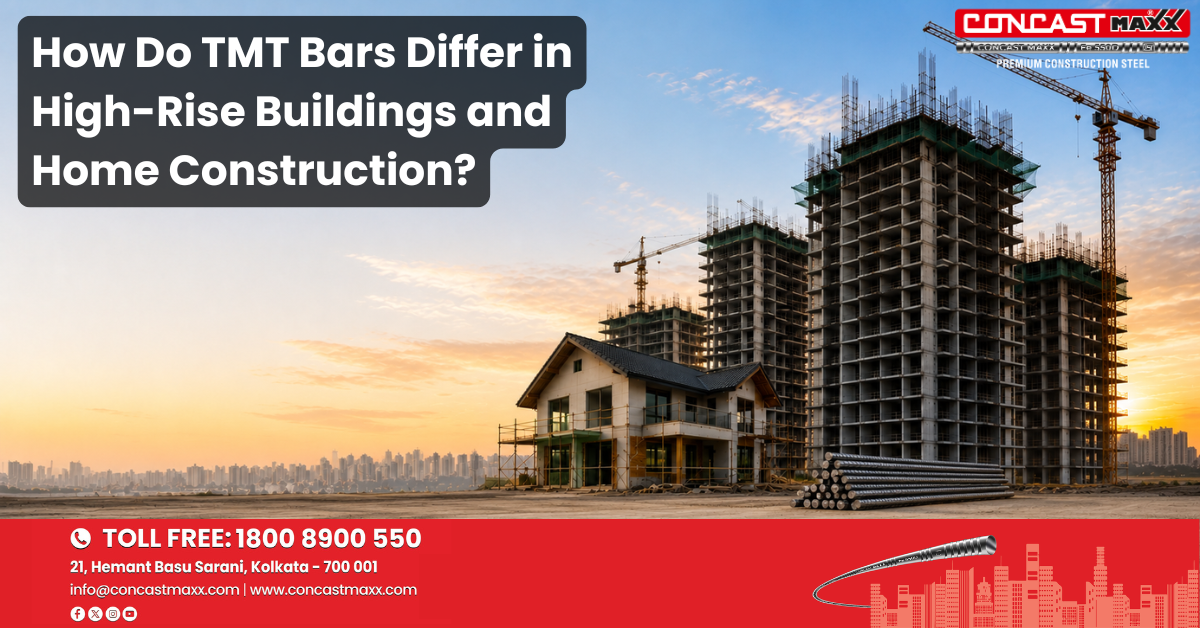
Imagine two construction sites.
One is a G+2 family home being built for generations to come. The other is a 25-storey residential tower that will accommodate hundreds of families. Both projects use reinforced concrete, both require TMT bars, and both aim for structural safety. Yet, the engineering behind these two structures is entirely different.
This often leads homeowners, contractors, and even first-time builders to ask:
“Can the same TMT bar be used for both?”
The answer isn’t simply yes or no. It depends on the building’s structural design.
A house and a high-rise may look similar once completed, but the forces acting on them throughout their lifespan are very different.
A residential home mainly carries the load of its own structure and the people living inside it. A high-rise building, however, supports dozens of floors, withstands stronger wind pressure, responds differently during earthquakes, and carries significantly greater loads every single day.
Tai engineering requirement-o completely alada hoy.
That is why structural engineers never select reinforcement steel based only on its grade or price.
Many people believe,
“Joto higher grade, toto stronger building.”
This is one of the most common misconceptions in construction.
A stronger TMT bar doesn’t automatically make a building safer.
Every structure is designed after calculating:
Only after these calculations does an engineer decide what reinforcement is actually required.
Using steel beyond the design requirement may increase the project cost without providing any meaningful structural advantage.
As buildings become taller, structural behaviour changes dramatically.
The reinforcement inside beams, columns, slabs and shear walls has to perform under continuous stress for decades.
High-rise projects therefore require reinforcement that delivers:
These characteristics help the structure perform exactly as intended by the structural engineer.
When people build their own house, the objective is slightly different.
The structure may not face the same level of loading as a commercial tower, but homeowners expect something equally important:
Peace of mind.
Nobody wants cracks appearing within a few years.
Nobody wants corrosion inside reinforced concrete.
Nobody wants expensive repairs after investing their life’s savings.
That is why residential construction should use TMT bars that offer dependable strength, good bendability, excellent bonding with concrete, and long-term durability.
Ekbar bari toiri hoye gele, pore repair kora onek beshi costly hoye jai.
Sometimes homeowners ask dealers,
“Sabse strongest TMT bar de dijiye.”
But experienced dealers usually ask a different question.
“Structural drawing mein kya recommend kiya gaya hai?”
That’s because reinforcement should always match the engineer’s design.
The objective isn’t to buy the strongest steel.
The objective is to build the safest structure.
Whether you’re constructing a home, apartment, hospital, factory or commercial complex, reinforcement should always come from a manufacturer that follows consistent production standards.
Before purchasing TMT bars, ensure they are:
In construction, consistency is often more valuable than simply claiming higher strength.
Every TMT bar may look similar from the outside.
However, manufacturing consistency, raw material quality, rolling technology, testing processes, and quality assurance can make a significant difference to long-term structural performance.
This is why experienced contractors and developers generally prefer manufacturers with proven production standards instead of choosing solely based on price.
Construction-e shortcut bole kichu hoy na. Quality always pays back over the life of the building.
Whether you’re constructing your first home or developing a multi-storey commercial project, reinforcement should always be selected according to structural calculations.
Choosing a trusted manufacturer, following BIS standards and using the grade recommended by your structural engineer are the most important decisions you can make during construction.
With Concast Maxx TMT Bars, every bar is manufactured with a focus on consistent quality, reliable performance and compliance with Indian standards, helping builders, contractors and homeowners build with confidence.
Q: Can one TMT bar be used for both houses and high-rise buildings?
A: Yes, if it matches the structural engineer’s design. The reinforcement is selected according to engineering calculations rather than the type of project alone.
Q: Why do high-rise buildings require different reinforcement planning?
A: High-rise structures experience greater structural loads, wind forces, and seismic effects, requiring carefully engineered reinforcement detailing.
Q: Is higher-grade steel always better?
A: No. The appropriate TMT bar is the one specified in the structural design. Higher grades do not automatically improve structural safety.
Q: What should homeowners check before buying TMT bars?
A: Always verify BIS compliance, manufacturing quality, consistency, authorised supply channels and your structural engineer’s recommendations.
Q: Why is manufacturing consistency important?
A: Uniform quality ensures predictable structural performance, stronger concrete bonding and long-term durability throughout the building’s service life.