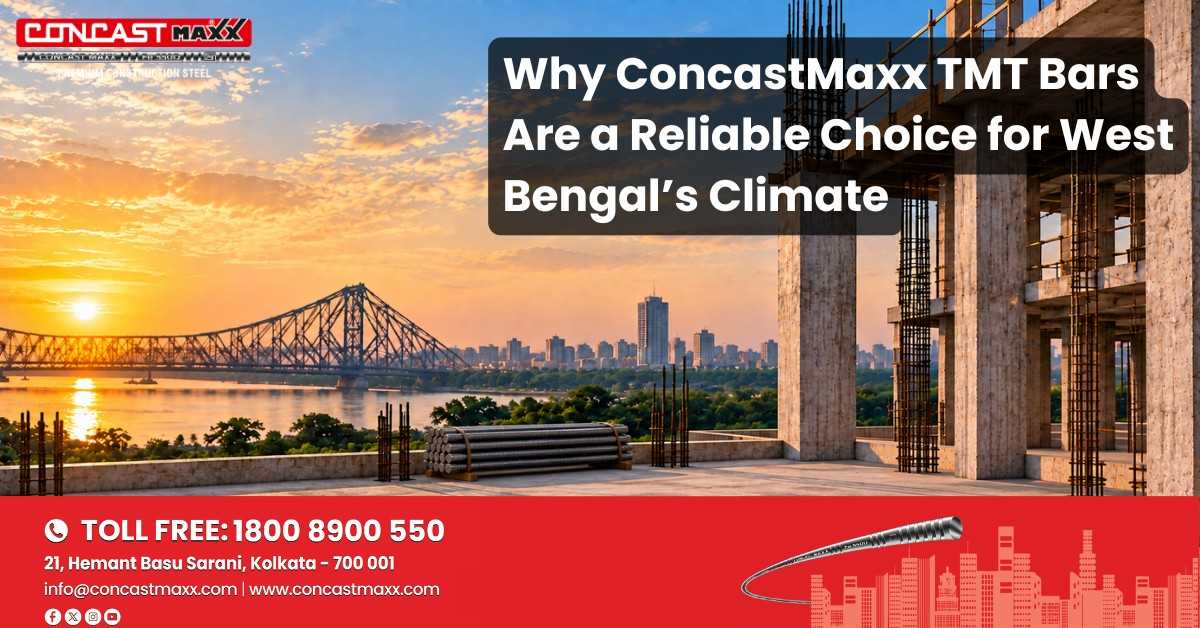
West Bengal presents a varied environment for construction. From the humid coastal areas of the Sundarbans and South Bengal to the heavy monsoon conditions across the state, buildings and infrastructure can face prolonged exposure to moisture, humidity, rainfall, and changing temperatures. In cyclone-prone areas, structures may also have to withstand strong wind forces.
These environmental conditions make selecting reinforcement steel an important part of construction planning. TMT bars are embedded inside concrete and provide the tensile reinforcement required to help reinforced-concrete structures carry loads and perform as designed.
For this reason, construction projects in West Bengal need reinforcement steel that combines the required strength with suitable ductility, concrete bonding characteristics, dimensional consistency, and reliable quality control.
ConcastMaxx TMT bars are manufactured with modern construction requirements in mind, providing reinforcement solutions for residential, commercial, industrial, and infrastructure projects across West Bengal.
Moisture is one of the major concerns when constructing in a humid environment. West Bengal experiences substantial rainfall during the monsoon, while areas closer to the Bay of Bengal can also experience higher humidity and exposure to saline conditions.
When reinforcement steel is exposed to moisture because of inadequate concrete protection, cracks, poor cover, or other factors, corrosion can become a concern. Corrosion causes steel to expand, which can place pressure on the surrounding concrete and contribute to cracking and deterioration over time.
The quality of the reinforcement steel is therefore one part of a broader durability strategy.
However, it is important to be clear: TMT bars alone cannot make a building corrosion-proof. Proper concrete mix design, adequate cover, correct reinforcement placement, good workmanship, drainage, and appropriate structural detailing are equally important.
Using properly manufactured TMT reinforcement as part of this system can help support the long-term durability objectives of the structure.
West Bengal includes areas exposed to strong seasonal weather and, particularly in coastal districts, the risk of cyclonic conditions. Structural design must account for the loads and forces relevant to the project’s location and intended use.
TMT reinforcement contributes to the structural performance of reinforced-concrete members by providing tensile strength and helping the structure respond to loads according to the engineer’s design.
At the same time, strength alone is not enough.
Ductility is an important characteristic of reinforcement because structural steel may need to undergo deformation while continuing to perform under demanding loading conditions. This becomes particularly relevant in structures designed for dynamic loads, including seismic actions where applicable.
The required grade, mechanical properties, reinforcement detailing, anchorage, lap lengths, and spacing should always be determined according to the structural engineer’s approved design and applicable standards.
ConcastMaxx TMT bars are manufactured to meet applicable IS 1786 requirements, providing project teams with reinforcement suitable for a range of structural applications when selected according to the project’s engineering specifications.
Reinforced concrete works because concrete and steel perform together. Concrete is highly effective in compression, while reinforcement steel provides the tensile capacity required by the structural design.
For this composite action to work properly, the reinforcement must develop an effective bond with the surrounding concrete.
The surface ribs on TMT bars create mechanical interlocking between the steel and concrete. Proper rib geometry, combined with correct concrete placement and adequate cover, helps reinforcement transfer forces effectively to the surrounding concrete.
This is particularly important in beams, columns, slabs, foundations, staircases, and other reinforced-concrete elements where reinforcement has to work together with concrete under structural loading.
The performance of the bond also depends on factors beyond the bar itself, including concrete quality, bar placement, development length, curing, and workmanship. Therefore, selecting quality TMT bars should be considered part of a complete reinforcement and concrete-quality system.
Construction projects require large quantities of reinforcement, often involving several bar diameters and multiple deliveries.
Consistency therefore matters.
Variations in bar dimensions, weight, mechanical properties, or identification can create challenges during procurement, fabrication, inspection, and reinforcement fixing. Consistent manufacturing helps contractors work more predictably with the Bar Bending Schedule and structural drawings.
ConcastMaxx focuses on controlled manufacturing and quality checks to provide TMT reinforcement for construction requirements.
Before the bars are used, project teams should verify the relevant product documentation, grade, diameter, identification markings, and test records against the purchase order and project specifications.
This provides a traceable process from procurement to reinforcement fixing.
West Bengal has a diverse construction landscape. Reinforcement requirements can vary significantly depending on the project.
TMT bars may be used in:
Each structural element can require a different combination of reinforcement diameters and quantities.
The correct selection should therefore be based on the structural drawings and Bar Bending Schedule rather than choosing reinforcement solely based on availability or price.
Construction near coastal regions requires additional attention to durability because saline moisture can increase the risk of corrosion when reinforcement is not adequately protected.
The coastal belt of West Bengal, including areas influenced by the Bay of Bengal, can face challenging environmental exposure. In such locations, durability planning should begin at the design stage.
The structural and civil engineering team may need to consider factors such as:
TMT bar selection is one component of this overall approach.
It would be inaccurate to claim that any TMT bar by itself eliminates corrosion in coastal construction. Long-term performance depends on the entire structural system and how well it is designed and constructed.
A reliable steel supply should come with documentation that allows the material to be verified at the project site.
Before reinforcement is incorporated into the structure, the site team can check:
Matching these details with the purchase order and structural requirements helps establish traceability.
This is especially useful on larger projects where steel arrives in multiple consignments. Proper records allow the quality team to identify which material was supplied, where it came from, and whether the relevant documentation corresponds with the physical bars.
For construction projects across West Bengal, selecting reinforcement steel should involve more than simply comparing market prices.
ConcastMaxx TMT bars are manufactured for reinforced-concrete construction applications and follow applicable IS 1786 requirements. Their use can extend across foundations, columns, beams, slabs, staircases, and other structural components, subject to the specifications prepared by the project’s structural engineer.
Whether the project is located in Kolkata, Howrah, Durgapur, Asansol, Siliguri, or another part of West Bengal, the appropriate TMT grade and diameter should be selected according to the structural design and environmental conditions of the project.
Project teams can also review the product documentation, bar identification, test certificates, and supply details before accepting reinforcement at the site.
West Bengal’s combination of high humidity, monsoon rainfall, coastal exposure in certain regions, and susceptibility to severe weather makes durability an important consideration in construction.
The right TMT bar can contribute to structural performance, but the material should not be viewed in isolation. Steel quality, concrete quality, structural detailing, adequate cover, proper curing, workmanship, and environmental exposure all influence the long-term performance of a reinforced-concrete structure.
For architects, engineers, contractors, and builders, the better approach is to select reinforcement that meets the project’s specified grade and applicable standards while maintaining proper material traceability and quality control throughout construction.
ConcastMaxx TMT bars provide a dependable reinforcement option for construction projects across West Bengal, helping project teams build according to the structural requirements laid out by their engineers.