Walk into any local steel market, and you’ll hear questions like these:
“Bhaiya, MS rod sasta hai. Ghar banane mein wahi use kar sakte hain?”
Or,
“Dekhne mein toh dono steel hi lagta hai. Toh difference kya hai?”
It’s a fair question.
After all, both Mild Steel (MS) bars and TMT bars are made from steel. Both are available in different sizes. Both are used somewhere in construction.
But here’s the important part:
They are not designed for the same purpose.
Choosing one over the other without understanding where each should be used can affect not only the durability of your project but also its long-term structural performance.
Think of it this way.
A family car and a heavy-duty truck both have four wheels.
But you wouldn’t use a family car to transport construction materials.
The same principle applies here.
While both products are steel, the manufacturing process, mechanical properties, and intended applications are completely different.
Tai dekhte eki rokom holeo, kaj completely alada.
Mild Steel bars have been used in fabrication work for decades.
Because they are easy to cut, bend, and weld, fabricators often prefer them for projects where structural reinforcement isn’t the priority.
You’ll commonly find MS bars in:
In these applications, ease of fabrication is more valuable than extremely high strength.
Now think about the parts of a building you never see after construction.
The foundation.
The columns.
The beams.
The slabs.
These elements quietly support the entire structure for decades.
That’s exactly where TMT bars are designed to work.
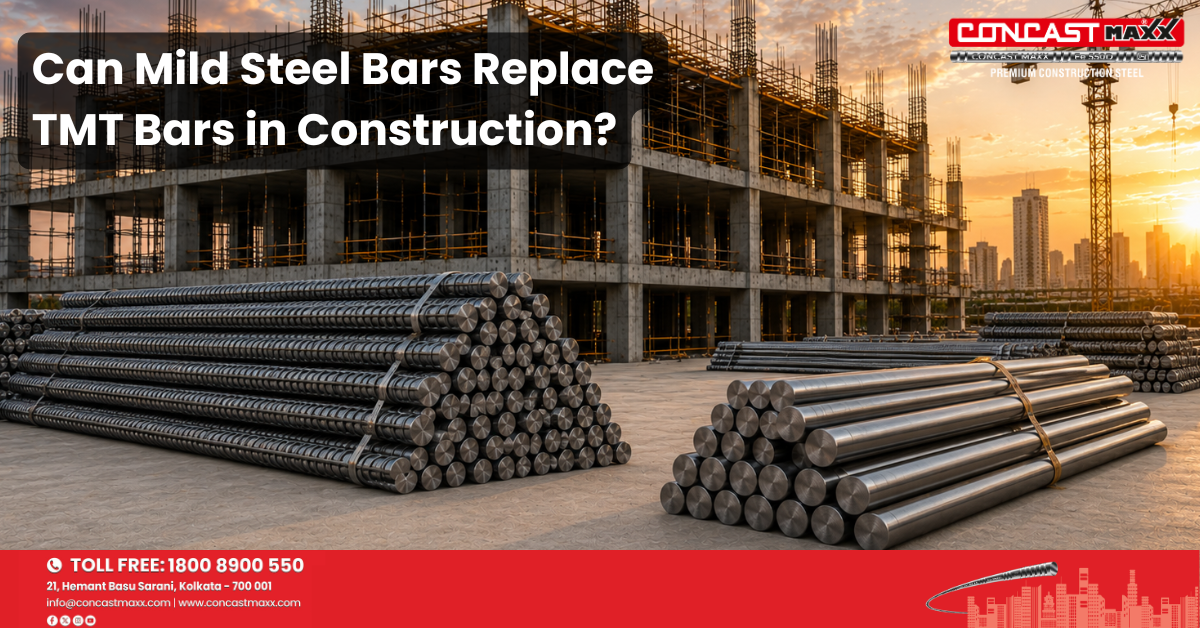
Unlike ordinary steel bars, TMT bars undergo a specialised thermo-mechanical treatment that creates a tough outer surface with a ductile inner core. This combination allows them to deliver the strength and flexibility needed for reinforced concrete structures.
Technically, Mild Steel bars have been used in older construction practices.
However, today’s residential, commercial, and infrastructure projects generally rely on TMT bars because they provide better overall structural performance.
Modern construction standards, engineering practices, and project requirements have evolved significantly over the years.
That’s why you’ll rarely see a new RCC building designed around plain Mild Steel reinforcement.
Sometimes homeowners try to reduce construction costs by choosing whichever steel appears cheaper.
At first, the savings may look attractive.
But reinforcement is not a place where decisions should be based only on price.
Construction-e steel change korar chance ekbar-i thake. Building complete hoye gele aar phire jawa jai na.
A better approach is to follow the structural drawing and choose reinforcement that matches the engineer’s specifications.
It’s Not About Which Steel Is Better
This is where many blogs get it wrong.
Mild Steel isn’t a “bad” product.
TMT isn’t automatically “better” for every application.
Each has a specific purpose.
If you’re fabricating a gate, Mild Steel can be an excellent choice.
If you’re reinforcing concrete that must safely carry loads for decades, TMT bars are the appropriate solution.
The material should always match the application.
Ask an experienced contractor where they try to save money on a project.
Very few will answer:
“Steel.”
Because once concrete is poured, the reinforcement becomes permanent.
Replacing tiles is possible.
Changing paint is possible.
Repairing reinforcement hidden inside reinforced concrete is far more complicated and expensive.
That’s why reputed builders generally prefer reinforcement manufactured with consistent quality, proper testing, and compliance with BIS standards.
Even after deciding to use TMT bars, selecting the right manufacturer is equally important.
Look for reinforcement that offers:
Concast Maxx TMT Bars are manufactured with these priorities in mind, helping homeowners, contractors, and developers build structures with confidence and long-term reliability.
Mild Steel bars and TMT bars are both valuable products, but they solve different problems.
Mild Steel remains an excellent choice for fabrication work such as gates, grills, and railings, where ease of welding and shaping is important.
TMT bars, on the other hand, are specifically engineered for reinforced concrete construction. Their superior bonding with concrete, high strength, ductility, and durability make them the preferred choice for modern homes, commercial buildings, and infrastructure projects.
Instead of asking “Which steel is stronger?”, ask “Which steel is right for this application?” That’s the question that leads to safer construction and smarter investment.