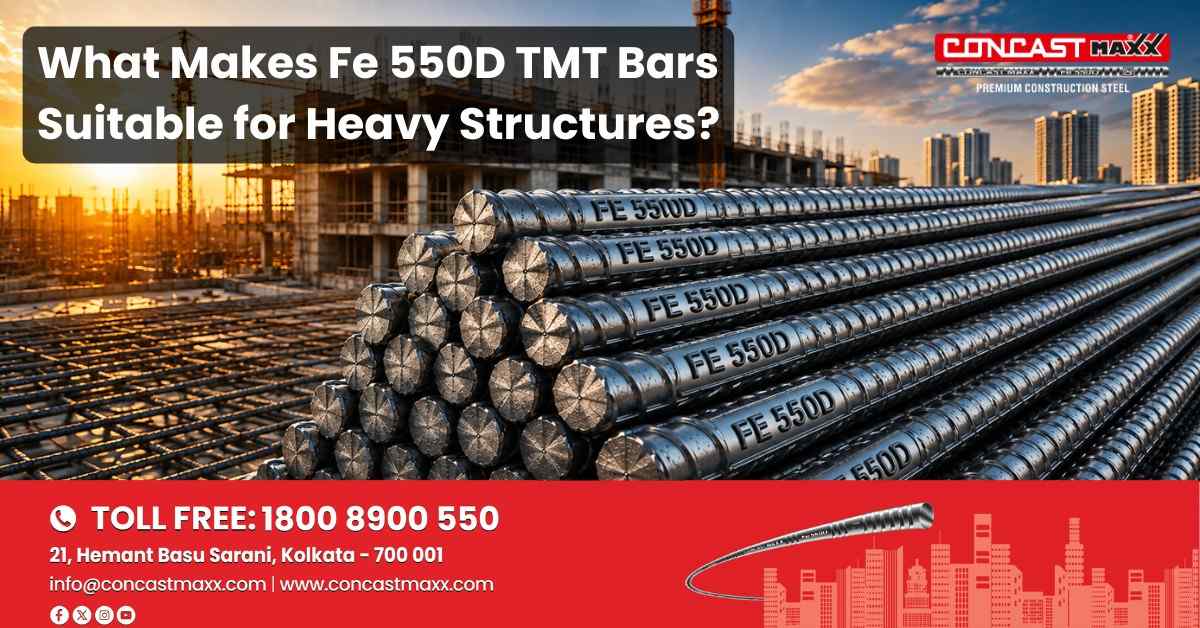
Heavy structures place demanding requirements on reinforcement steel. High-rise buildings, industrial facilities, bridges, flyovers, metro infrastructure, and other large-scale projects need reinforcement that can withstand substantial loads without compromising structural reliability.
This is where Fe 550D TMT bars can become a suitable choice. The “550” refers to the specified minimum yield strength of 550 N/mm², while the “D” designation indicates enhanced elongation compared with the corresponding non-D grade. Under IS 1786, Fe 550D is one of the specified grades of high-strength deformed steel reinforcement.
But high yield strength alone does not make a reinforcement grade appropriate for every heavy structure. Its combination of strength, ductility, bond characteristics, and manufacturing quality is what makes Fe 550D relevant for demanding applications.
One of the primary advantages of Fe 550D is its high yield strength. A higher yield strength allows the reinforcement to withstand greater stress before permanent deformation begins.
This characteristic can be valuable in structures where reinforcement is expected to carry substantial tensile forces. Depending on the structural design, higher-strength reinforcement can also allow engineers to achieve the required capacity with an efficient reinforcement arrangement.
However, this does not mean that Fe 550D should automatically replace lower grades in every project. The reinforcement grade must match the structural design, applicable codes, detailing requirements, and project specifications.
Strength without adequate ductility is not enough for demanding construction.
The “D” in Fe 550D represents a grade with enhanced specified elongation compared with the corresponding Fe 550 grade. This means the steel is designed to provide a better combination of strength and deformation capacity.
Ductility matters because structures can experience loads that are not perfectly static or predictable. Reinforcement with suitable ductility can undergo deformation before failure, providing a more desirable response under demanding loading conditions.
This characteristic is particularly relevant when structural resilience and controlled deformation are important considerations.
Large structures often experience significant combinations of dead loads, live loads, wind effects, seismic actions, and other forces. Reinforcement needs to transfer these forces effectively through the concrete structure.
Fe 550D provides a high-strength reinforcement option that can be considered where the design requires greater yield strength. Its use may be particularly relevant in heavily loaded structural components such as columns, beams, foundations, shear walls, and other reinforced concrete elements.
The actual suitability, however, depends on structural calculations rather than simply selecting the highest available grade.
Strength is only useful when reinforcement can effectively work with concrete.
Fe 550D TMT bars have a ribbed surface that provides mechanical interlocking with surrounding concrete. The rib geometry helps create the bond needed to transfer forces between steel and concrete.
IS 1786 includes requirements related to deformation and surface characteristics, and BIS testing provisions include pull-out and bond-strength testing.
A consistent rib pattern therefore matters because reinforcement must maintain effective interaction with the concrete throughout the embedded length.
A high-strength grade is only as reliable as its manufacturing consistency.
Chemical composition, heat treatment, rolling conditions, dimensional accuracy, rib geometry, and mechanical properties all need to remain within the applicable requirements. BIS documentation for IS 1786 identifies testing related to yield stress, tensile strength, elongation, chemical composition, deformations, bending, rebending, and bond behaviour.
For buyers, this means the grade designation alone should not be the deciding factor. Test certificates and compliance with the applicable standard are equally important.
Fe 550D can be considered for projects where higher-strength reinforcement is required by structural design. Potential applications include:
Its use should always follow the structural engineer’s design and applicable project specifications.
Q1. What does Fe 550D mean?
Fe 550D is a high-strength deformed reinforcement grade. “550” refers to the specified minimum yield strength of 550 N/mm², while “D” indicates enhanced elongation requirements.
Q2. Is Fe 550D stronger than Fe 500D?
In terms of specified minimum yield strength, Fe 550D has a higher value than Fe 500D. However, the appropriate grade depends on structural design rather than strength alone.
Q3. Why is Fe 550D suitable for heavy structures?
Its combination of high yield strength and enhanced ductility can make it suitable for structures subjected to significant loads and demanding design conditions.
Q4. Can Fe 550D be used in every construction project?
No. Choosing a higher grade simply because it is stronger is poor engineering practice. The required grade should be determined by structural design, codes, detailing, and project requirements.
Q5. What should buyers check before purchasing Fe 550D?
Buyers should verify compliance with applicable standards, mechanical properties, dimensions, rib characteristics, chemical composition, and quality-test documentation.
Fe 550D TMT bars offer a combination that matters in demanding construction: high yield strength with enhanced ductility. This makes the grade a relevant reinforcement option for heavy structures where both load-carrying capacity and controlled deformation are important.
Still, the grade itself is not a guarantee of structural performance. Proper structural design, concrete quality, reinforcement detailing, construction practices, and consistent manufacturing all contribute to the final result.
For heavy construction, the smarter approach is to select Fe 550D when the engineering requirements call for it, and to source it from a manufacturer that can demonstrate consistent quality and compliance with the applicable standards.