TMT (Thermo-Mechanically Treated) bars form the backbone of reinforced concrete structures. While concrete provides excellent compressive strength, it has relatively low tensile strength. TMT bars are embedded within concrete to resist tensile forces, improve structural stability, and enhance the building’s ability to withstand heavy loads, earthquakes, and environmental stresses.
From the foundation to the roof slab, TMT bars play a vital role in ensuring that every structural component performs as intended. Understanding where and why they are used can help homeowners, builders, and construction professionals appreciate their importance in safe and durable construction.
Quick Answer
TMT bars are primarily used in foundations, columns, beams, and slabs to reinforce concrete. They improve tensile strength, distribute structural loads, resist cracking, and increase the overall durability and stability of residential, commercial, and industrial buildings.
Concrete performs exceptionally well under compression but can crack when subjected to tension. TMT bars compensate for this limitation by providing the tensile strength required to keep the structure stable under different loading conditions.
The main benefits of using TMT bars include:
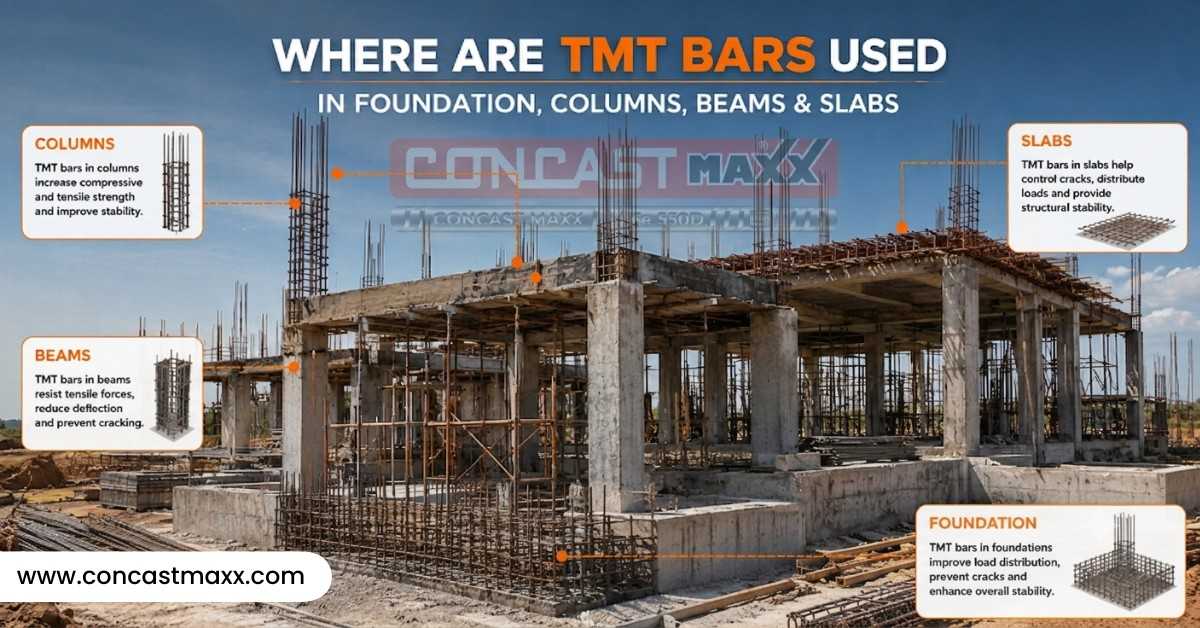
The foundation transfers the entire weight of the building to the ground. It experiences both compressive and tensile forces due to soil movement, settlement, and structural loads.
TMT bars reinforce the foundation by:
Proper reinforcement in the foundation helps create a strong base that supports the entire structure throughout its lifespan.
Columns are vertical structural members responsible for transferring loads from beams and slabs down to the foundation.
TMT bars inside columns help:
Since columns are among the most critical structural components, reinforcement must always follow the structural engineer’s design specifications.
Beams are horizontal members that transfer loads from slabs to columns.
They experience significant bending moments, making reinforcement essential.
TMT bars in beams help:
The placement and diameter of reinforcement bars vary depending on the beam’s span and the expected structural load.
Slabs form the floors and roofs of a building.
Although concrete carries compressive loads effectively, slabs require reinforcement to handle tension caused by bending.
TMT bars in slabs provide:
Proper reinforcement ensures that slabs remain strong while supporting occupants, furniture, and equipment.
Apart from the primary structural components, TMT bars are also used in:
Their versatility makes them suitable for almost every reinforced concrete construction project.
Using quality TMT bars alone is not enough. Proper reinforcement detailing and placement are equally important.
Construction professionals should ensure:
Incorrect placement can reduce the effectiveness of reinforcement and compromise structural safety.
Can TMT bars be used in all parts of a building?
Yes. TMT bars are used in foundations, columns, beams, slabs, staircases, retaining walls, and several other reinforced concrete components.
Why are TMT bars used with concrete?
Concrete is strong in compression but weak in tension. TMT bars provide the tensile strength needed to improve structural stability and prevent cracking.
Which part of a building uses the most TMT bars?
The quantity varies depending on the structural design. Foundations, columns, beams, and slabs typically account for the majority of reinforcement used in residential buildings.
Does every building require TMT bars?
Most reinforced concrete structures rely on TMT bars for strength and durability. The grade, diameter, and quantity depend on the project’s engineering design.
TMT bars are an essential component of modern reinforced concrete construction. From strengthening foundations to reinforcing columns, beams, and slabs, they help distribute loads, resist tensile forces, and improve the long-term durability of a structure.
Selecting high-quality TMT bars and ensuring they are installed according to structural design specifications contributes to safer, stronger, and more reliable buildings. Whether constructing a home or a commercial project, understanding where TMT bars are used highlights their critical role in creating structures that stand the test of time.